
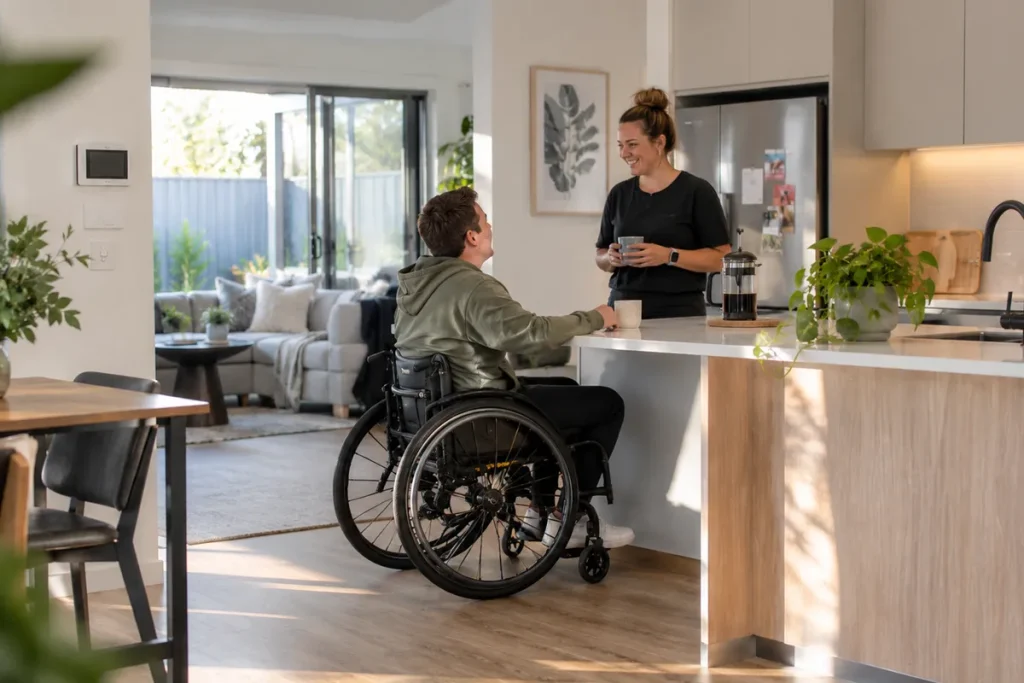
Specialist Disability Accommodation should do more than meet a checklist of accessibility requirements. It should provide a home that supports independence, safety, comfort and the way each person wants to live.
That thinking sits at the heart of the current NDIS Specialist Disability Accommodation (SDA) Design Standard Review, which has now reached an important stage.
The National Disability Insurance Agency (NDIA) appointed KPMG Australia to independently review the existing SDA Design Standard and develop the next edition, SDA Design Standard Edition 2.0. Following consultation with participants, families, carers and the broader SDA sector, a Technical Working Group has now been established to help inform the proposed changes.
For people currently living in SDA, considering SDA for the future, or supporting someone through that journey, here’s what we know so far.
Why is the SDA Design Standard being reviewed?
The current SDA Design Standard was first introduced in 2019 and became mandatory for new-build and new-build refurbished SDA from 1 July 2021. A lot has changed since then.
There have been advances in accessible design, assistive technology, sustainability and building practices, alongside a growing body of lived experience from people actually living in SDA homes. The NDIA says the review is intended to ensure future SDA continues to provide safe, high-quality housing that meets participants’ needs.
This matters because the Standard influences many of the practical details that can make a significant difference to everyday life – including entrances, doorways, room dimensions, kitchens and bathrooms, flooring, storage, lighting, landscaping, power points and assistive technology.
What is the latest SDA Design Standard Review update?
Consultation for the review is complete following consultation with NDIS participants, families and carers, disability and community organisations, as well as people involved in designing, building, investing in and providing SDA.
The review has now moved into its next stage, with a Technical Working Group established to provide expert advice on potential changes to the Standard.
The group brings together expertise from accessibility, occupational therapy, housing, construction, fire safety, government and the SDA sector. Its members include representatives from the Access Consultants Association, Access Institute, SDA Alliance, Master Builders Australia, the Australian Building Codes Board and other specialist organisations.
Consulting company, KPMG, will use the consultation feedback alongside advice from this group to help shape the next edition of the Standard and consider how any changes should be implemented.
What could change in SDA Design Standard Edition 2.0?
At this stage, it is important to distinguish between what is being reviewed and what has actually changed.
The final Edition 2.0 Standard has not yet been published, and the existing SDA Design Standard remains the relevant standard for current requirements.
However, the Terms of Reference show that the review is considering how SDA design can better respond to developments in accessibility, assistive technology, sustainability and contemporary building practices. NDIS
The four existing SDA design categories are also part of the current framework:
- Improved Liveability
- Fully Accessible
- Robust
- High Physical Support. NDIS
The review is an opportunity to consider how the physical design of SDA homes translates into better real-world outcomes for the people who live in them.
Why lived experience matters
A home can comply with a design standard and still need to work for the individual living there.
Someone using a wheelchair may experience a kitchen very differently from someone with sensory or cognitive support needs. The positioning of a doorway, circulation space around furniture, storage accessibility, lighting or the way assistive technology integrates into a home can all influence how independently and comfortably someone can live.
That is why it’s encouraging to see participant experience included in the review process.
The NDIA’s consultation specifically sought input from participants and their families and carers, alongside technical and industry expertise.
For AccessAccom, that reflects something we see every day: good accessible housing starts with the person, not simply the property.
What does the review mean if you’re looking for SDA now?
You don’t need to put your search for a suitable SDA home on hold. There has been no announcement that the existing Standard has been replaced, and the NDIA is still developing the next edition and considering how it will eventually be implemented.
If you are currently exploring SDA, the more immediate questions remain personal ones:
- Does this home work for me?
- Does the location suit my life?
- Can I move around comfortably?
- Does the home support my level of independence?
- Can my preferred supports work effectively here?
- Can I see myself feeling at home here?
The technical classification of an SDA dwelling is important, but it is only part of choosing somewhere to live.
Looking beyond minimum standards
At AccessAccom, we welcome the continued focus on improving the quality of Specialist Disability Accommodation. Standards provide an important foundation, but our approach has always been to look beyond the building itself.
We take time to understand the people who may call our properties home, their preferences, support needs, independence, lifestyle and what’s important to them.
Because accessible features work best when they’re part of a home that also provides choice, privacy, dignity and a genuine sense of belonging.
Looking for Specialist Disability Accommodation?
If you or someone you support is currently looking for SDA, you don’t need to wait for the new Design Standard to begin exploring your options. Talk to our friendly team about your needs, preferred location and the type of home you’re looking for, or explore our SDA properties.
Remember to sign up to our newsletter and follow us on socials to stay up to date with NDIS changes.